The Jazan Qa'adah: A Craft Reviving the Memory of the Home and Renewing Its Global Presence
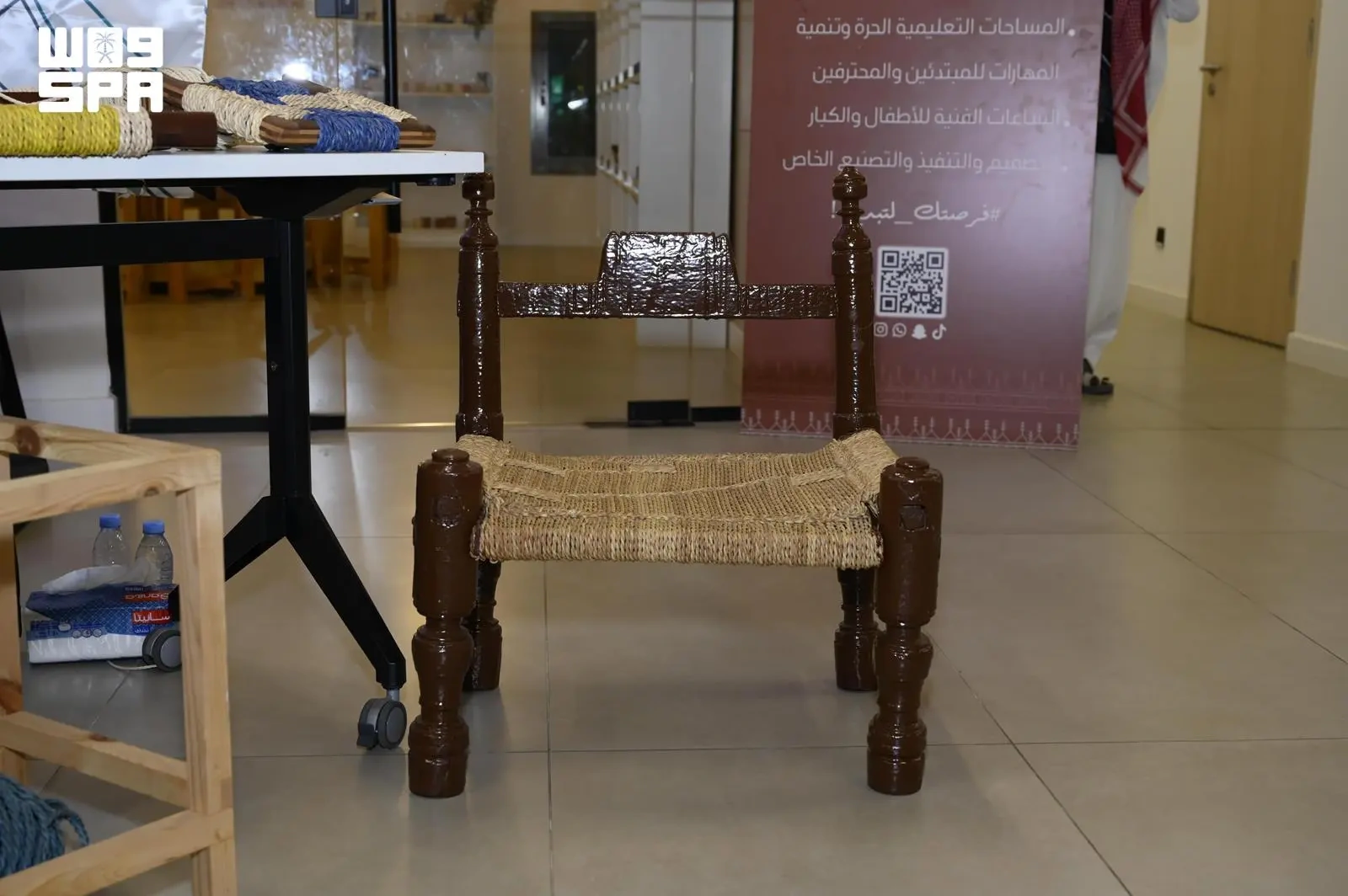
Pieces of old Jazani household furniture retain details of craftsmanship that stand as testimony to man's skill in harnessing the resources of his environment and turning them into products that combine sturdy workmanship with beauty of form.
Among the most famous pieces of Jazani furniture is the "qa'adah," a large seat that the people of Jazan would place at the head of the 'ushsha (thatched hut) and reserve for special occasions, while using smaller versions in their daily gatherings.
From this piece — whose frame the carpenter builds from local wood and whose surface the "muhabbil" weaves with ropes made of doum palm fronds — the craftsmen of the Jazan House of Artisans drew inspiration for the "Qa'aid Craft Mural," which the Heritage Commission announced on December 14, 2025, had won the silver award in the 2025 New York Global Product Design Awards.
The making of a "qa'adah" begins with the selection of wood, the most commonly used local variety being sidr wood, from which the carpenter builds a rectangular frame about 2 meters long and 1 meter wide, consisting of two long planks each known as a "sari'" and two short planks each known as a "ra's" (head). The frame rests on four legs called "rukub" (knees), each about 75 centimeters high.
The carpenter trims the edges of the "sari'" and "ra's" planks, smoothing them and giving them a slight curve to reduce friction and wear from use, then shapes the ends of the planks to fit into sockets he carves at the top of the four legs, fitting each end into place until the frame is secured and ready for weaving.
Once the wooden frame is complete, a specialized craftsman known as the "muhabbil" weaves the seat's surface in a stage called "tahbil," using ropes twisted from "tufi" — doum palm fronds after being bleached and prepared to the appropriate measurements. The muhabbil stretches the ropes across the frame in successive passes, adjusting the spacing between them and the degree of tension until the qa'adah has a cohesive surface that retains its flexibility.
The muhabbil relies on simple tools to align, tighten, and fasten the ropes. Alongside the quality of the wood and ropes, the precision of the weaving depends on his experience in handling doum fronds and his judgment of how much tension the rope needs at each stage, until its rows line up evenly across the frame.
Women handle the fastening of a mat woven from doum palm fronds onto the qa'adah's surface, protecting the ropes from rapid wear and completing the piece's appearance. Qa'aid seats vary in size and purpose, including heritage models known by local names such as the "ghazali" and the smaller "shibri," as well as a chair to which a wooden backrest is added.
With changing lifestyles and the spread of modern furniture, the importance of teaching qa'adah-making to new generations has grown — from knowledge of the woods and the names of the qa'adah's parts, to preparing the ropes and mastering the tahbil weaving.
As part of the Heritage Commission's efforts to revive and develop traditional handicrafts, training at the Jazan House of Artisans covered the making of "qa'aid" seats, alongside cap knitting and seashell handicrafts. Some 30 male and female artisans enrolled in the program, which over the course of a year combined specialized training with workshops on innovation, design, entrepreneurship, and marketing, and provided artisans with a space to produce and display their wares.
The program included developing products suited to contemporary use and market demands, in which the artisans employed geometric ornaments and modern colors alongside natural materials, while preserving in their designs the components and techniques that distinguish each craft.
On February 13, 2026, the Heritage Commission announced, at a ceremony held at the Prince Sultan Cultural Center in Jazan, that the number of licensed male and female artisans in the region had exceeded 270, and that the Jazan House of Artisans had produced more than 2,000 handicraft products.
The male and female artisans who took part in producing the "Qa'aid Craft Mural" were honored at the ceremony, in recognition of their contribution to transforming inherited craft knowledge into a work of art that earned international acclaim, and to highlight the role of artisans as bearers of this knowledge and makers of its continuity.