Optical Illusion on Mars: NASA Reveals the Secret of the Mysterious 'Forest' and Dunes Moving 4.7 Metres
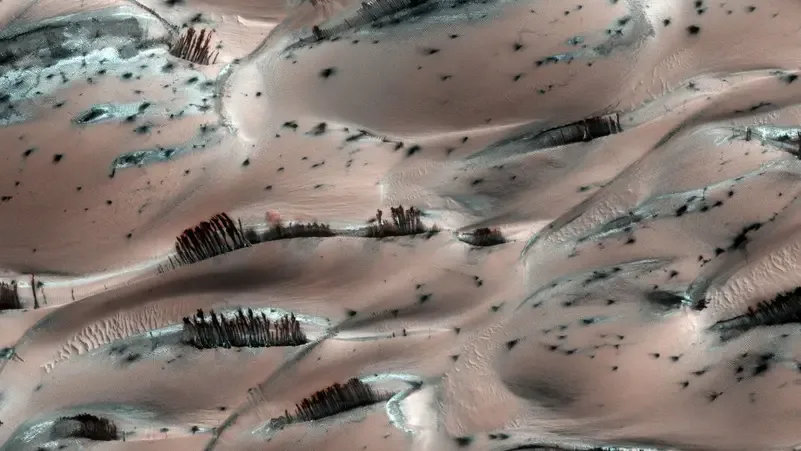
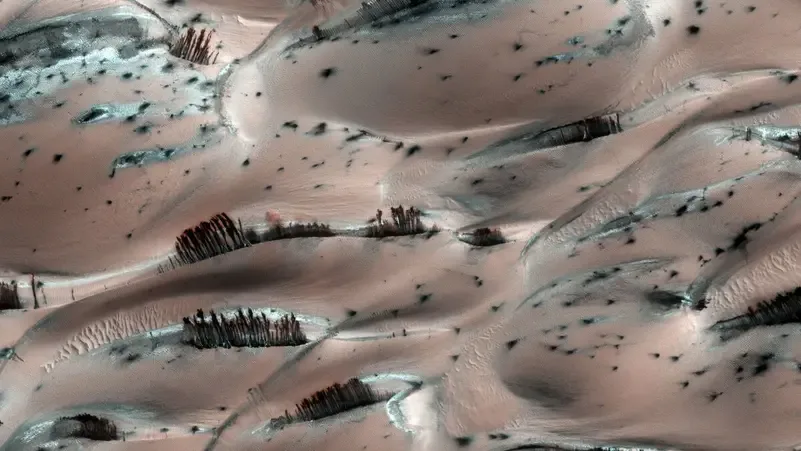
NASA has revealed that the dark, tree-like shapes near Mars' north pole are not vegetation, but streaks of sand left behind by the sublimation of frozen carbon dioxide with the arrival of spring, a phenomenon that reshapes sand dunes and alters the planet's surface features.
Among Mars' icy dunes, dark shapes resembling tangled trees appear, as if a strange forest had suddenly grown on the surface of the Red Planet. A scene that stuns at first glance, but conceals a natural phenomenon revealing how seasonal change can reshape Mars' terrain in unfamiliar ways.
The image, captured by NASA's Mars Reconnaissance Orbiter in 2008 near the planet's north pole, shows no plant forms, but dark streaks of sand that surged down the slopes of frozen dunes, driven by seasonal transformations linked to carbon dioxide freezing and turning to gas with the arrival of spring, according to ScienceAlert.
An Optical Illusion from Space
Viewed from above, the sandy streaks in the image look like tree trunks and branches, but turning the image upside down reveals their true nature, clearly showing the trails of dark sand that slid down the sides of the dunes.
During Mars' harsh winter, carbon dioxide in the atmosphere freezes and falls as frost and snow, forming a layer of dry ice covering the polar regions. With the arrival of spring, this ice does not melt as it does on Earth, but transforms directly from solid to gas in a process known as sublimation.
Sunlight, though weak on Mars, penetrates the relatively transparent ice layer and heats the sand beneath it, causing gas to accumulate and pressure to build before it bursts outward, carrying dark sand grains with it.
A Phenomenon That Reshapes the Dunes
The sand flows down the dunes' steep slopes, leaving long dark streaks that resemble trees when seen from space. The high-resolution HiRISE camera captured a small dust cloud in the original image, believed to have resulted from sand moving down the slope.
The phenomenon was not limited to the appearance of these streaks; a study published in 2011, led by the late planetary scientist Candice Hansen-Koharcheck, found notable changes in sand dunes near Mars' north pole after comparing images taken over consecutive Martian years.
The researchers observed new grooves and hollows appearing in some dunes, along with accumulations of sandy deposits at the base of the slopes. In 5 dunes that were measured, the lower edges of the slopes advanced by distances ranging from 2.2 to 4.7 metres over a single Martian year, clear evidence of the ability of seasonal transformations to alter the surface of the Red Planet.