Makkah Gate: A Towering Mushaf Welcoming Arrivals to the Muslims' Qiblah and Showcasing the Beauty of Islamic Identity
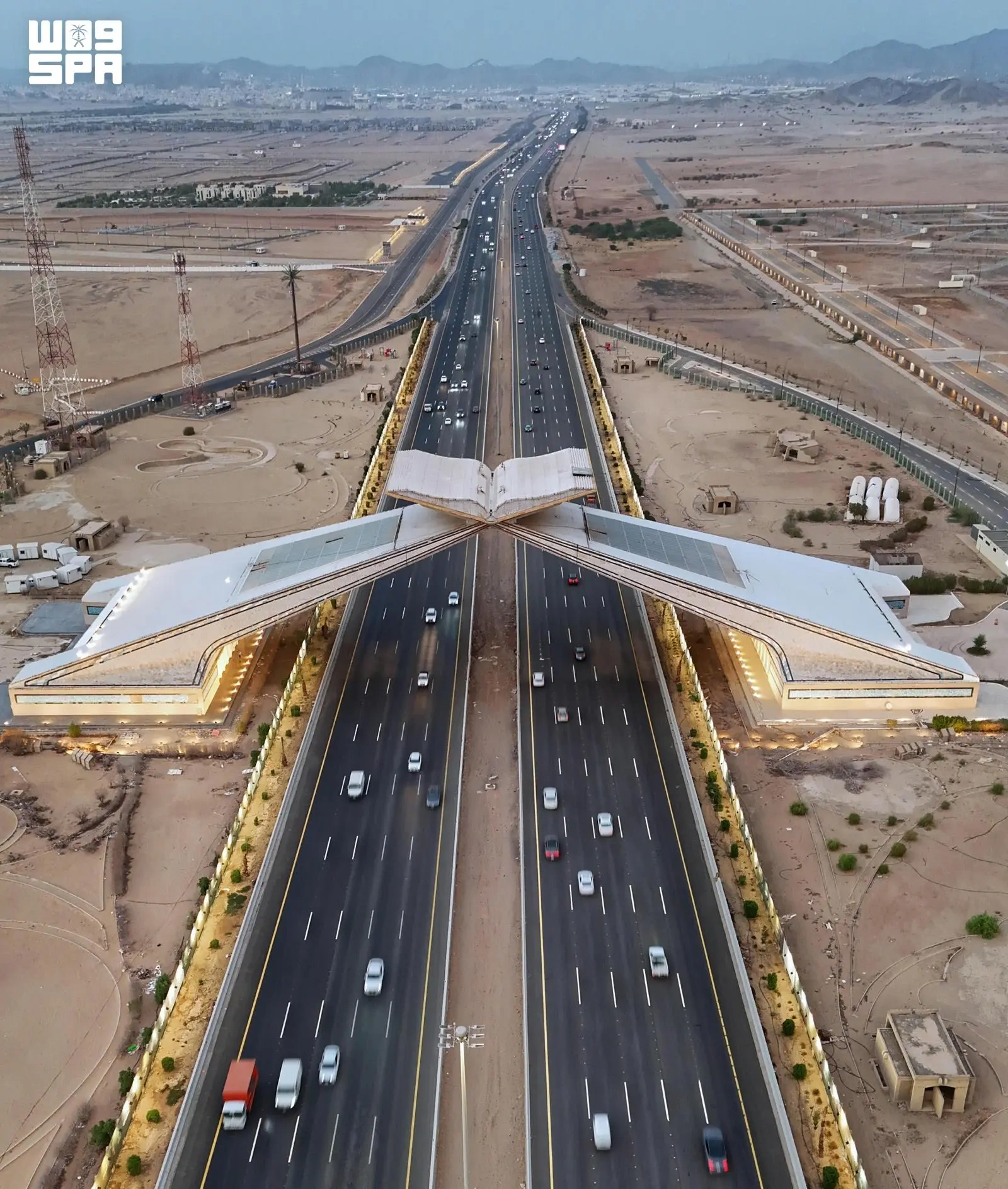
In an architectural scene that captures the attention of those arriving in the holy capital, the Makkah Gate stands out as one of its most prominent civilizational landmarks and visual symbols, welcoming visitors from the direction of the Makkah-Jeddah road with an exceptional design inspired by the greatness of the Holy Quran and its place in Muslims' hearts. The gate takes the form of a noble Mushaf resting on a Quran stand, in an engineered composition that combines architectural beauty with the significances of Islamic identity, making it more than just a gateway and a symbol embodying the uniqueness of the place and its spiritual stature.
The gate, also known as the 'Mushaf Gate,' stands out with its unique design depicting the open Holy Mushaf on a Quran stand as a massive architectural structure, consisting of an arch spanning the road and comprising three main units: two side bases forming two supporting blocks for the wings, and two wings extending from the bases to meet at a height of about 23 meters above the road, forming the base of the open book that represents the most prominent element in the gate's architectural composition.
The open book consists of two pages, each about 16.5 meters long and 26 meters wide, extending from a height of 23 meters to 31 meters above the road, in a design that gives the structure a majestic visual presence and makes it a striking architectural landmark welcoming those arriving in Makkah.
The design of this landmark is attributed to Saudi visual artist Aziz Diya, who drew inspiration from the wooden Mushaf stand, transforming this familiar Islamic symbol into a work of art with broad architectural dimensions. Reinforced concrete was used as the main building material, along with glass, wood, and illuminated Islamic mosaics beneath the arches, while Islamic ornaments, patterns, and Arabic calligraphy added an aesthetic character in harmony with the identity of the holy capital.
The gate is located on Prince Mohammed bin Salman Road, known as the Makkah-Jeddah Expressway, about five kilometers west of Makkah. The structure measures about 152 meters in length and 31 meters in width, surrounded by palm trees, manicured gardens, and parking lots, and its aesthetic details stand out at night through various lighting systems that give it a striking visual presence.
The Holy Capital Municipality affirmed that it pays attention to developing and humanizing the main entrances and improving the urban scene, through development and rehabilitation works on the Prince Mohammed bin Salman axis, including the western entrance to Makkah from the Jeddah direction, through tree planting, landscaping of public spaces, enhancement of aesthetic elements, and promoting integration between architectural landmarks and surrounding facilities, highlighting Makkah's identity and improving the experience of residents, visitors, and Guests of God from the moment they arrive in the holy capital.
The aesthetic value of the Makkah Gate is not limited to its architectural design, but extends to its symbolic significance reflecting the uniqueness of the holy capital and its Islamic identity. The Holy Mushaf at the center of its architectural composition embodies the status of the Holy Quran in Muslims' hearts, and this symbolism complements urban improvement works and the development of the surrounding environment, making the gate a prominent landmark that combines authenticity and development and reflects Makkah's stature in welcoming arrivals from around the world.
The Makkah Gate embodies a model of the meeting of visual art with Islamic architecture, and the ability of creative design to transform cultural and religious symbols into enduring urban landmarks that help shape cities' visual identity and strengthen their presence in visitors' memory, carrying meanings that transcend the boundaries of place into the depth of history, culture, and sentiment.
The Makkah Gate is a distinctive architectural landmark at the entrance to the holy capital from the Jeddah direction, with its design inspired by the Holy Mushaf resting on a wooden stand reflecting Islamic symbolism and architectural innovation, and highlighting the care given to showcasing Makkah's identity and its religious and civilizational stature.