Saudi Arabia to Manufacture 'Sky Wasp' Drone with 1,100 km Range in Riyadh
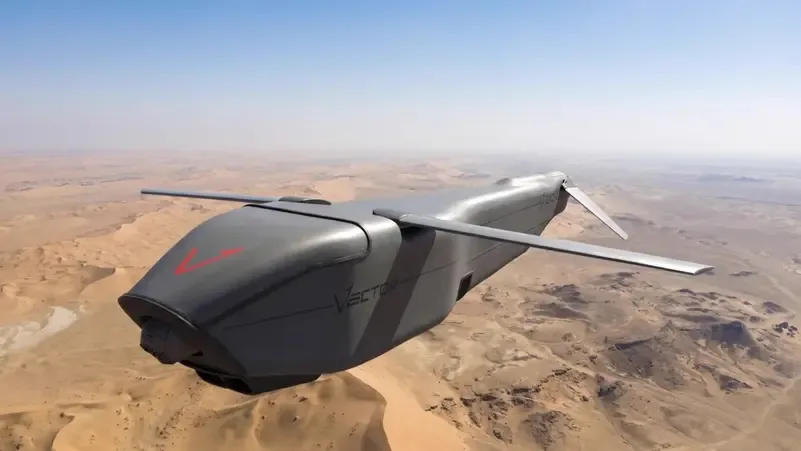
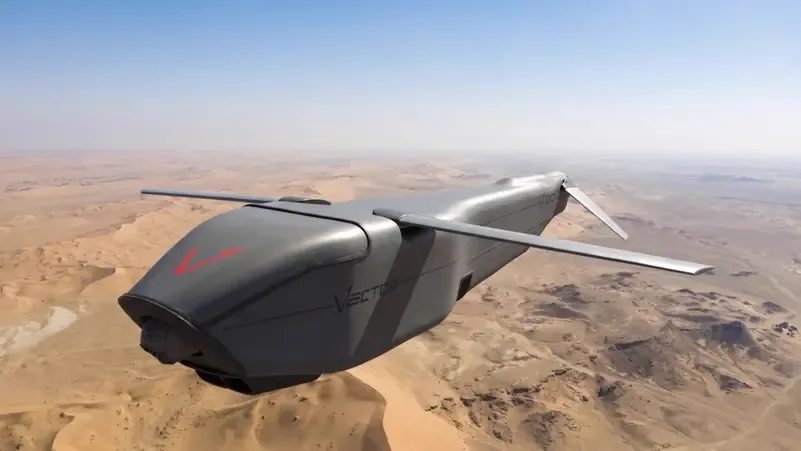
U.S. company 'Vector' has announced a joint venture with Saudi 'SR2' to manufacture the 'Bombard' attack drone in Riyadh under the name 'Sky Wasp', with a range of 1,100 kilometers, a payload of 50 kilograms, and a navigation system independent of GPS, while the drone remains under engineering testing.
U.S. company 'Vector' announced a joint project with Saudi company 'SR2' to manufacture the 'Bombard' attack drone in Riyadh under the name 'Sky Wasp', as part of a drive to produce long-range attack drones on a large scale.
The drone's announced range reaches 1,100 kilometers, which it covers in about two and a half hours, compared to more than 5 hours needed by the Iranian 'Shahed' drone to cover 1,000 kilometers, which shortens the warning time available to air defense systems compared to slower drones.
'Sky Wasp' is powered by a multi-fuel pulse jet engine with few moving parts, and launches from a ground platform with a cruising speed of up to about 380 kilometers per hour, in a design aimed at simplifying manufacturing and supporting large-scale production.
According to the announced specifications, the drone relies on an autonomous navigation system that allows it to be guided to the target without depending on GPS, while its payload is 50 kilograms with an interchangeable warhead depending on the nature of the mission.
In this context, CEO of 'Vector', Andy Yakoulis, said that 'Bombard' represents a direct response to the Iranian 'Shahed' drone and its Russian version 'Geran', amid the rapid expansion in the use of long-range attack drones globally.
However, the drone is still undergoing engineering testing and verification, despite the company announcing a flight test of one of its versions. The unit cost, the target production volume, and the specified delivery date have not yet been disclosed, as the assessment of actual performance remains tied to test results before moving to full-scale production.
The project reflects a trend toward localizing the manufacture of systems that combine speed, long range, adjustable payload, and the ability to be produced in large numbers.
In the same context, data from Saudi Arabia's General Authority for Military Industries revealed that the kingdom's military spending localization rate rose to 27.3% in 2025, exceeding the annual target of 24%. This result falls within the targets of 'Saudi Vision 2030', which aims to localize more than 50% of military spending.