Oil Storage Tanks: The Gulf's New Weapon for Protecting Markets and Boosting Global Influence
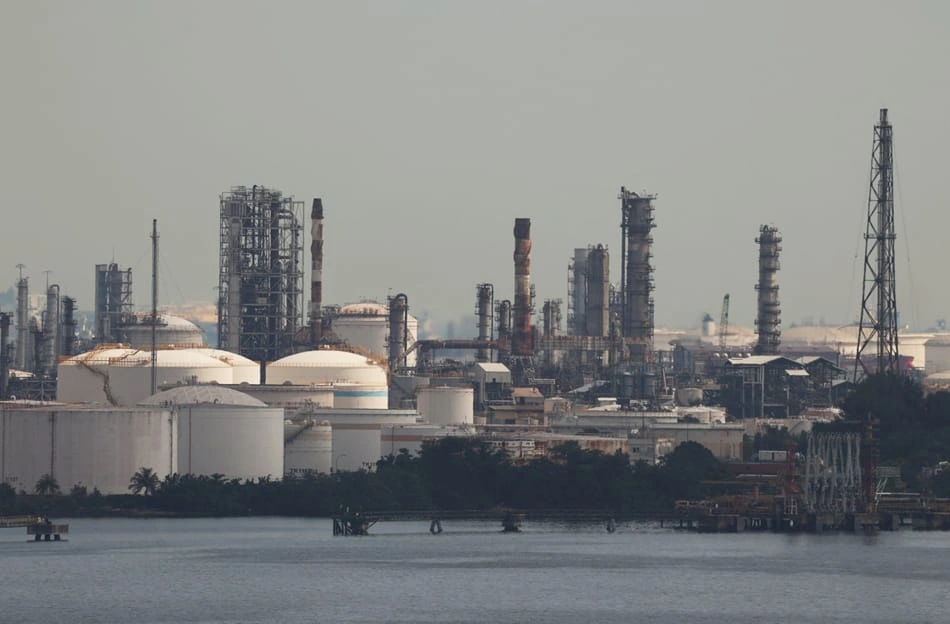
The battle for Gulf energy security is no longer limited to protecting oil fields or ensuring continued production; it has extended to a more sensitive question: how can oil reach markets when export routes are disrupted? Facing maritime corridor risks and geopolitical turmoil, Gulf states are expanding their network of oil storage tanks beyond their borders, from Asia to Africa, in a strategy that combines securing supplies, protecting market share, and enhancing economic influence.
Hormuz Exposed Weaknesses.. and Pipelines Are Not Enough
According to a report on the Al-Majalla website, navigation disruptions in the Strait of Hormuz in 2026 exposed the fragility of reliance on maritime corridors, after supplies representing about 30% of global oil exports and 20% of liquefied gas exports were disrupted. Brent crude exceeded $100 a barrel, while European gas prices rose by about 60%.
Gulf states differ in their ability to overcome the crisis; Saudi Arabia owns the East-West pipeline to the port of Yanbu with a capacity of up to 7 million barrels per day, while the UAE's Habshan-Fujairah pipeline provides capacity ranging between 1.5 and 1.8 million barrels per day. Kuwait, Qatar, and Bahrain, however, do not possess similar alternative export routes bypassing the strait.
But the crisis showed that pipelines are not enough, as they may be vulnerable to attacks or unable to accommodate full exports, while financial reserves cannot compensate for disrupted oil flows over long periods.
Asia: Gulf Storage Tanks in the Heart of Consumer Markets
Asia receives more than 80% of crude oil shipments passing through Hormuz, making it the most important destination for the overseas storage strategy.
Saudi Arabia, the UAE, and Kuwait are cooperating with Japan and South Korea to store oil in strategic facilities that allow producers to use the stockpiles commercially under normal conditions, while granting host countries preferential rights to obtain supplies during emergencies.
These partnerships are expanding toward India, where the UAE stores about 6 million barrels in Mangalore and is studying raising its storage capacity there to 30 million barrels. Saudi Arabia also plans to store oil in the Jurong caverns in Singapore, in a project expected to begin operations in the second half of 2027.
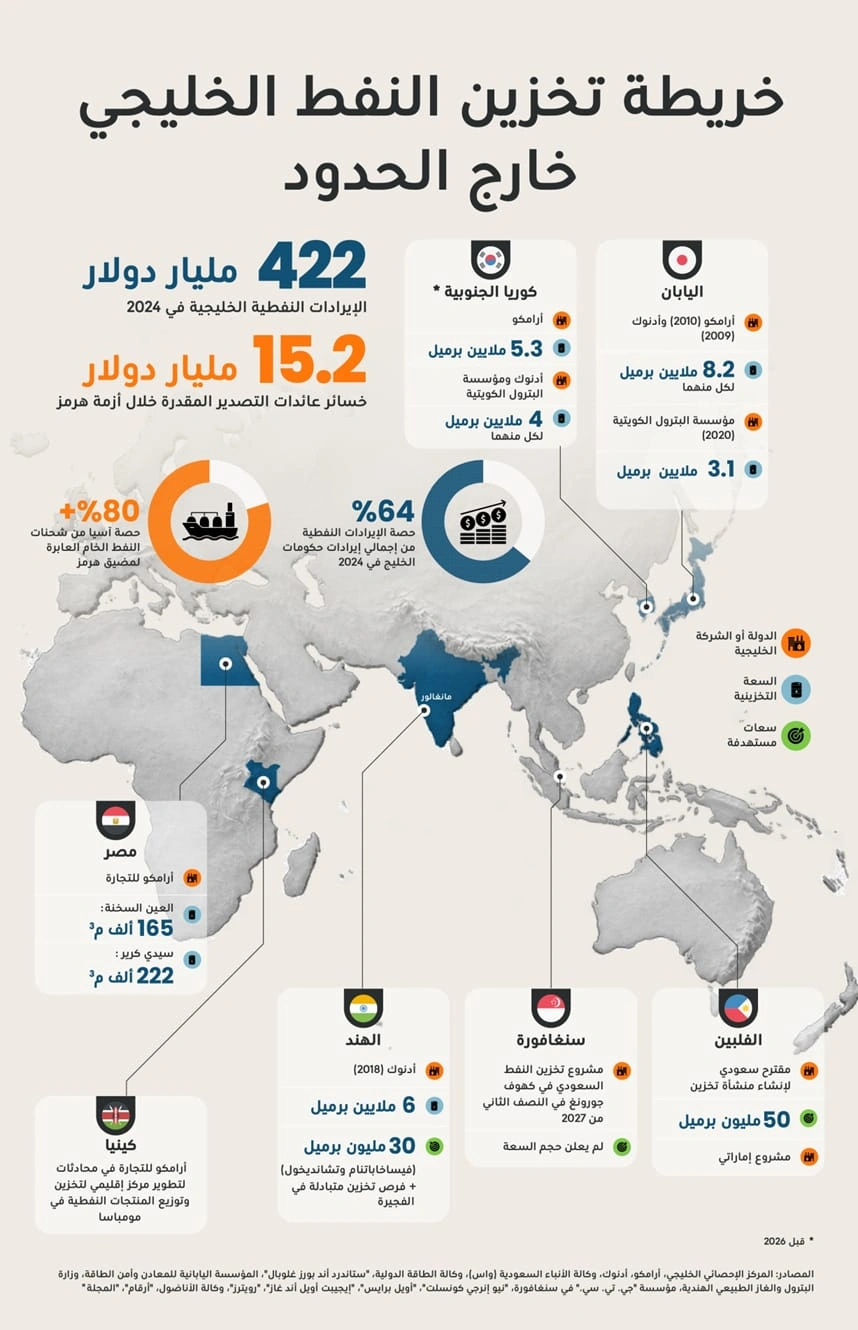
Gulf companies are pursuing diverse models that include leasing commercial tanks, depositing oil in shared strategic facilities, financing facilities they own, or developing storage centers in partnership with host countries.
The Philippines and Pakistan stand out among proposed project destinations, while Saudi Arabia and the UAE are looking to boost their energy presence in Africa through Egypt and Kenya, particularly the port of Mombasa, which could become a distribution hub for petroleum products in East Africa.
Overseas storage tanks give the Gulf the advantage of staying close to buyers, reducing delivery times, strengthening long-term trade relations, and generating returns from trading and logistics services.
But stockpiles remain limited, some projects have not gone beyond the negotiation stage, and oil heading to some African centers remains exposed to the risks of crossing Hormuz or Bab al-Mandab.
The report concludes that the future of Gulf energy security will not depend on the size of reserves alone, but on integrating overseas storage, pipelines, alternative transport routes, and international partnership networks; real strength lies not merely in owning oil, but in the ability to deliver its barrel to market when the routes are disrupted.