Giant Moon Adorns the Kingdom's Sky
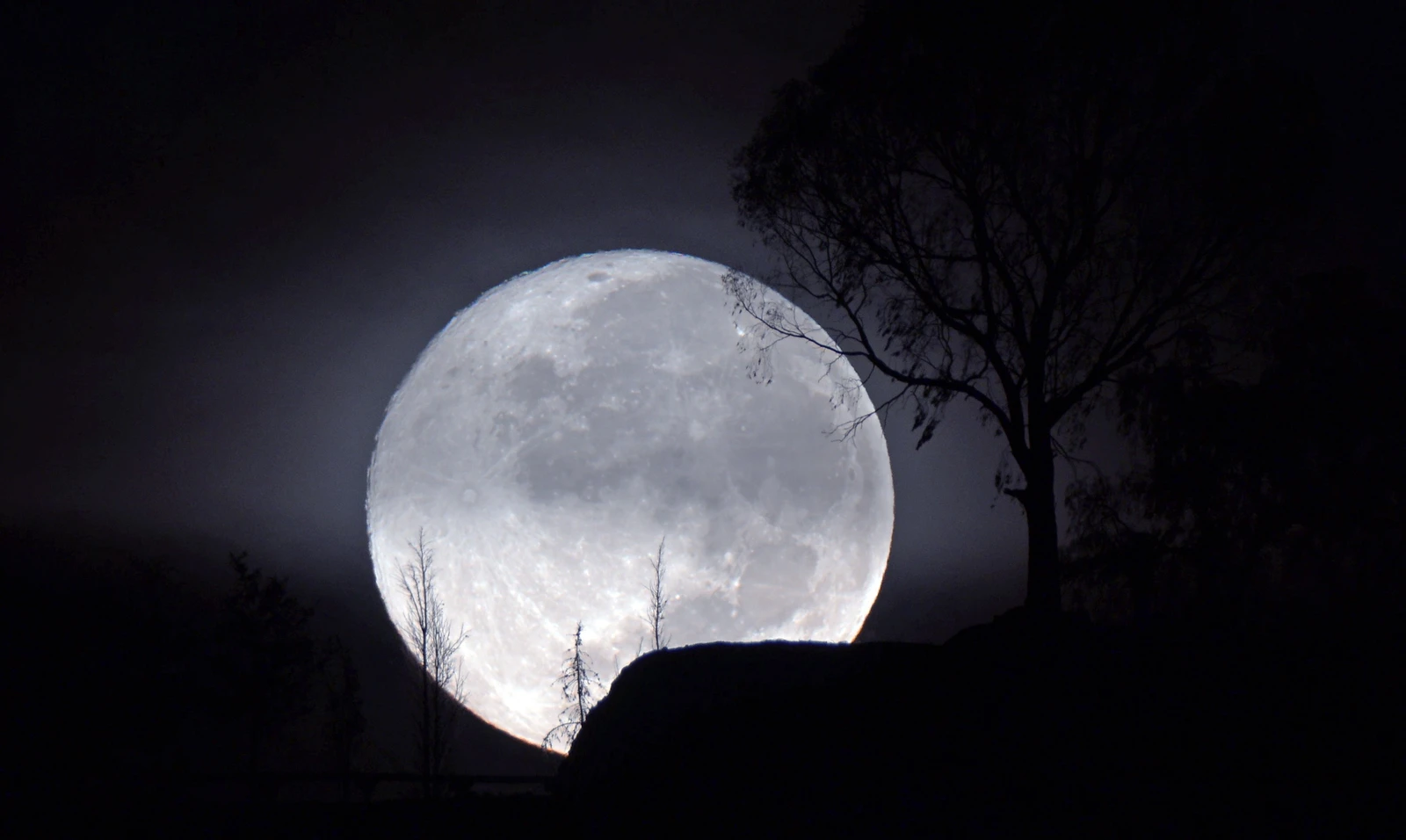
The sky over the Kingdom witnessed the full moon today (Tuesday), in a striking astronomical phenomenon marked by the brilliance of the "giant moon," which has been proposed to be named the "Olive Full Moon," coinciding with the olive harvest and pressing season in the Kingdom, drawing the attention of astronomy enthusiasts and astrophotographers.
The giant moon appears up to 14% larger
Majed Abu Zahra, chairman of the Jeddah Astronomical Society, explained that the moon became full this evening at a distance of approximately 361,000 kilometers from Earth, and is described as a "giant moon" because its fullness coincides with its closest approach to Earth in its elliptical orbit, known as the "lunar perigee." He noted that the moon will reach its actual perigee tomorrow, Wednesday, at 11:58 p.m. Mecca time, at a distance of approximately 359.3 thousand kilometers from Earth.
He pointed out that the giant moon appears up to 14% larger and up to 30% brighter compared to the smallest full moon of the year, when the moon is at its farthest point in its orbit, known as "apogee." He drew attention to the fact that the moon rose above the eastern horizon around sunset, appearing orange or reddish as its light passed through a thicker layer of the atmosphere, then gradually shifted to its usual silvery-white color as it climbed higher in the sky, remaining visible throughout the night.
He explained that the proposal to name November's full moon the "Olive Full Moon" was inspired by the olive harvest and pressing season in the Kingdom, particularly in the regions of Al-Jouf and Tabuk, where olives are an authentic part of the agricultural identity. The aim is to link the astronomical scene to a prominent agricultural season in local memory, stressing that it is a proposed cultural designation and not an established astronomical or heritage name.
At the same time, he affirmed that the giant moon does not cause earthquakes or weather disasters, contrary to some widespread beliefs, but may naturally enhance the "perigean spring tide" phenomenon as a result of the alignment of the sun, Earth, and moon and the increase in gravitational force. He noted that moonrise is the most suitable time for photography enthusiasts to capture it alongside natural landmarks and buildings, taking advantage of the optical phenomenon known as the "moon illusion."