Lebanese Anger Over Israeli Army Spokeswoman's Storming of Children's School; Adraee Admits Mistake
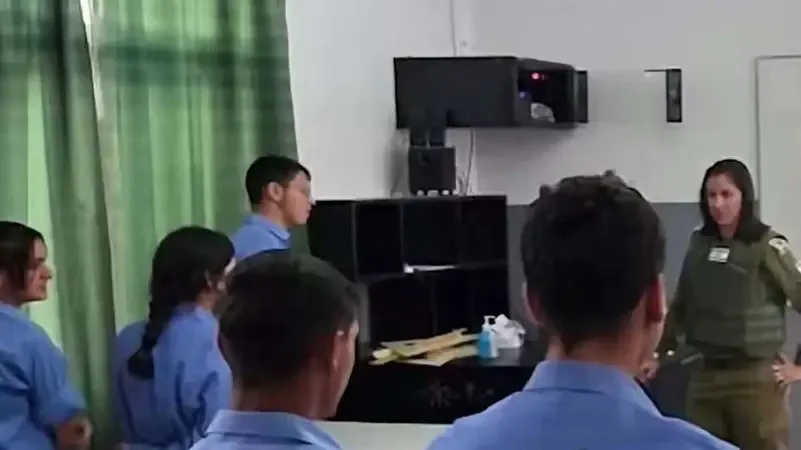
Lebanese Education Minister Rima Karami considered the entry of Israeli spokeswoman Ella Waweya into the school in the border town of Dibel a military storming rather than a visit, while Avichay Adraee described publishing the photos as a wrong decision, without a clear apology for entering the school or involving the students.
The fallout from Israeli army spokeswoman Ella Waweya's storming of a school in the border town of Dibel in southern Lebanon did not stop at the wave of official and popular condemnation triggered by the video, but extended into a new dispute between Lebanese officials and the Israeli side.
Lebanese Education and Higher Education Minister Rima Karami considered what happened not a visit but a "military storming of a school attended by children no older than 15," while former Israeli army spokesman Avichay Adraee acknowledged that what happened was "a very wrong decision."
The Lebanese Education Minister's Position
The Lebanese education minister rejected describing what happened as a visit, saying it was a "storming in military uniform by an occupier of a school in an occupied area," noting that the presence of Israeli forces in the school, amid the security and psychological conditions facing the region's residents, exploited the children's state of fear and created an atmosphere captured in a video clip before it circulated on social media and news outlets.
In her remarks to Al-Arabiya/Al-Hadath, Karami stressed that publishing the video during Lebanon's Independence Day celebrations "was provocative in the extreme," referring to the anger and questions raised by the scenes over the exploitation of an educational institution and civilian schoolchildren in a display of a military and media nature.
Adraee: Publishing the Photos Was a Mistake
For his part, Adraee, the former Israeli army spokesman, acknowledged in an interview with Israel's Channel 12 that publishing the photos of the Dibel school was "a very wrong decision," but said it was not intentional.
Adraee explained that the mistake was tied to several factors, chief among them the timing and place of publication and the people appearing in the scenes, adding that Israel should steer clear of what he called the "traps" set by Hezbollah, which he accused of trying to bolster its standing at the expense of its opponents inside Lebanon.
However, Adraee's remarks contained no clear apology for entering the school or involving the students in the filmed scenes, as he focused on the fallout from publishing the content and its timing, and on what he considered political exploitation of the incident by Hezbollah.
What Happened at the Dibel School?
The incident began after Israeli army spokeswoman Ella Waweya posted a video clip on Sunday on the X platform, showing her in front of the school in the border town of Dibel, including scenes from inside the school and interaction with the students, as part of her congratulations to the Lebanese on Independence Day.
The clip sparked a wave of widespread criticism in Lebanon, prompting Prime Minister Nawaf Salam to issue a statement denouncing what he described as "the Israeli army's storming of the official Dibel school and dragging the students into a military and propaganda display," adding: "An occupation force has no right to exploit our children to beautify the image of its occupation or impose its grip on our people in the south."
Following the video's spread, the Dibel municipality rushed to clarify the circumstances of the incident, after residents of the town faced accusations and criticism on social media, with some even accused of collaboration. The municipality confirmed that the visit was not tied to Independence Day but took place about a month earlier without any coordination with the school administration, stressing that residents remained committed to staying in their town despite the difficult security conditions.
Context and Sensitivity of the Incident
The incident carries added sensitivity given the conditions in which Dibel's residents live; it is one of a limited number of border villages where some residents have remained over the past two years, despite Israeli evacuation orders that accompanied the ground invasion of southern Lebanon. Residents live in isolation from the rest of the country, amid difficulties securing their basic needs and heavy reliance on humanitarian aid, amid the continuing Israeli military presence in the area.
Despite the decline in the pace of violence in southern Lebanon since June, following a US-Iranian memorandum of understanding and then the signing of a framework agreement between Lebanon and Israel under US auspices, tension persists as Israeli strikes on southern areas continue.
The framework agreement includes arrangements for disarming Hezbollah and a gradual Israeli withdrawal from areas occupied during the war, but the Israeli army still controls a strip of territory extending to a depth of about 10 kilometers from the border, where it carries out demolition and bulldozing operations, while preventing residents from returning to their areas.