At 13.1 Billion Years Old, Euclid Telescope Spots Oldest Known Quasar Baffling Scientists
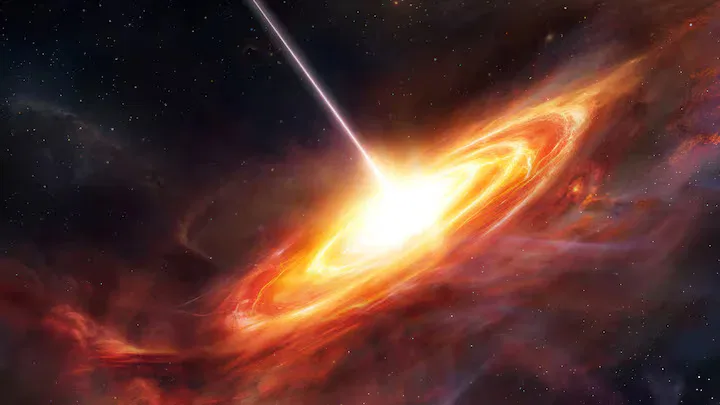
Astronomers have discovered the oldest known quasar, formed about 630 million years after the Big Bang, powered by a black hole with a mass of roughly 360 million times that of the sun, raising questions about how fast black holes grew in the early universe.
The European Space Agency's Euclid telescope has detected a quasar dating back more than 13.1 billion years, formed just 630 million years after the Big Bang, making it the oldest known quasar in the history of astronomy, surpassing the previous record-holder, identified last July, by 40 million years.
Quasars are among the most energetic and luminous objects in the universe; they are the extremely bright cores of galaxies, drawing their energy from a supermassive central black hole. The researchers named the newly discovered quasar 'Don Ingsa,' after an ancient stone fort in Ireland perched atop a cliff overlooking the Atlantic Ocean.
Astronomer Julien Wolf of the European Southern Observatory in Germany, lead author of the study published in the scientific journal 'Astronomy and Astrophysics,' said: 'I think this adds to the evidence that some objects in the early universe evolved remarkably fast. Just 630 million years after the Big Bang, this black hole had already grown to about 360 million times the mass of the sun, and was shining as a quasar.'
After Euclid first spotted the quasar, a combination of ground-based and space telescopes worked to determine its properties in greater detail.
ثقب أسود يتحدى الفهم العلمي
The supermassive black hole in 'Don Ingsa' has a mass about 90 times that of the black hole at the center of our Milky Way galaxy. The supermassive black hole powering a quasar is typically billions of times more massive than the sun, which makes its growth to such enormous size in a very short time a genuine scientific mystery.
Astronomer Silvia Belladitta of the Max Planck Institute for Astronomy in Germany and the Bologna Observatory for Astrophysics and Space Science, part of Italy's National Institute for Astrophysics, who took part in preparing the study, explained: 'When enormous quantities of gas, dust and matter fall toward the black hole, they form a spinning disk whose temperature rises to extreme levels and radiates vast amounts of energy, outshining the rest of the entire galaxy by hundreds or even thousands of times.'
Belladitta added: 'This makes quasars visible from billions of light years away, allowing us to observe them from the very early stages of the universe. Studying quasars helps astronomers understand how the first galaxies formed and evolved, and how the supermassive black holes at their hearts grew to reach these enormous sizes.'
حقبة تحولات كونية
'Don Ingsa' dates back to one of the most turbulent and transformative eras of the universe; after the Big Bang, the universe cooled into a dark fog of hydrogen gas, then the first stars and galaxies ignited, and their intense radiation slowly pierced this fog, making the universe transparent to light for the first time.
Belladitta said: 'This process was still ongoing when this quasar and its host galaxy were forming. It is a fascinating era in which to discover such an object, as the supermassive black hole powering this quasar grew to an enormous mass in a very short time, which challenges our understanding of how black holes grew to such size so quickly in the early universe.'
نظريتان لتفسير النشأة
The researchers propose two main possibilities to explain the emergence of this massive black hole so early in the universe's history: the first is that it began small, following the death of a first-generation star, but observations indicate it was devouring matter at a rate far too slow to reach its enormous mass that quickly. The second is that it was born large through what is known as 'direct collapse.'
Wolf explained this second scenario, saying: 'Usually, a large gas cloud cools and breaks up into smaller clumps that form stars. Under the right conditions, the gas may stay warm enough to limit this fragmentation, allowing much of it to flow toward the center. This gas could form a single enormous star that rapidly collapses into a black hole, and this black hole would initially be far more massive than the remnant of a typical first-generation star.'
آفاق اكتشافات أبعد
The researchers believe the Euclid telescope may discover quasars even more distant and older than 'Don Ingsa,' as theoretical models suggest the first quasars may date to between 270 and 470 million years after the Big Bang.
Belladitta concluded: 'In short: this is the farthest quasar we have ever seen, but it may not be the farthest that can be discovered.'