Saudi Arabia Cuts Forecast for 2026 Economic Contraction as Budget Deficit Estimates Hold Steady
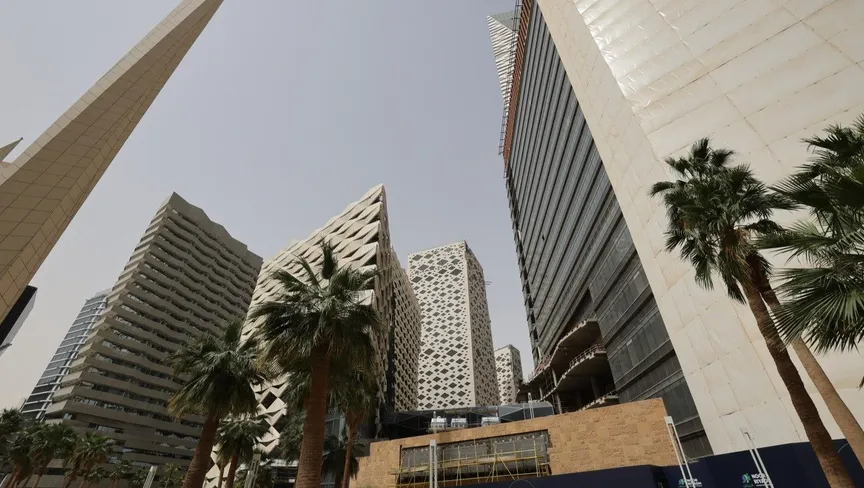
Saudi Arabia has lowered its estimate for an economic contraction in 2026 and kept its forecast for a narrower budget deficit compared with last year, signaling a recovery in oil production and resilience in government revenues despite fallout from the military escalation in Yemen and the Gulf.
Data from the annual budget approved by the government on Tuesday showed gross domestic product is expected to shrink 2.1%, versus 3.6% in the preliminary statement issued at the end of September, coinciding with the kingdom's oil output rising to its highest level since the start of the war. The non-oil economy was estimated to grow around 2.5%.
The government expects the Arab world's largest economy to regain momentum next year, achieving growth of 10.9% — the fastest pace since 2022.
The government kept its forecast that revenues will reach 1.191 trillion riyals against spending of about 1.436 trillion riyals. The budget deficit came in at 4.9% of gross domestic product, versus 5.8% in 2025, despite the war widening and Iran-aligned Yemeni Houthi militias targeting civilian sites including King Khalid International Airport and the King Abdullah Financial Center in Riyadh.
Mohammed bin Salman: Budget Balances Supporting Growth with Delivering Priorities
Crown Prince and Prime Minister Prince Mohammed bin Salman said the budget "comes as part of long-term fiscal planning that balances supporting sustainable growth, delivering development priorities, and strengthening the sustainability of public finances, while maintaining flexibility in directing resources and continuing to fund programs and projects with economic and social impact."
"What Happened Did Not Surprise Us"
The annual budget figures showed military spending holding at 254 billion riyals this year, up only 2% from last year, with forecasts of a 3.5% rise in 2027.
Finance Minister Mohammed Al-Jadaan attributed the stability of the forecasts to conservative fiscal planning by the ministry in particular and the state in general.
He added, in response to a question from Asharq Bloomberg during a meeting with a group of journalists: "What happened between September and today did not surprise us. We live in this country and in this region."
He continued: "Asking about the threats you face, the assets you need, and the resources required to deal with them is part of the essence of this work. With all this noise, military spending in 2026 rose only about 2%... This shows we were prepared."
Private Consumption Growth
The figures and the minister's remarks reflect confidence in the resilience of the Arab world's largest economy despite continued shipping and navigation disruptions in the Strait of Hormuz, as higher oil prices and Saudi Aramco's ability to boost exports helped shore up revenues. The state also deployed its financial buffers to increase investment spending and support domestic demand.
This is reflected in forecasts for private consumption growth for the sixth consecutive year, with 2026 estimates pointing to a 2.9% rise in real terms, versus 3.4% in 2025. Fixed investment outside the government sector also returned to growth of 0.9% after falling 4.1% last year.
Al-Jadaan also cited tourism as an example, asserting that domestic demand succeeded in offsetting a roughly 7% decline in inbound tourism through the end of September, adding: "Some destinations are actually struggling to meet demand."
The Cost of War
In contrast, the data showed the cost of the war, with the budget deficit exceeding the 2026 target of 3.3% of the size of the economy.
Growth in the non-oil sector slowed to its weakest pace in several years, affected by the fallout from the conflict, which coincided with a reordering of spending priorities for Vision 2030 projects and a slowdown in bank lending growth.
The ministry's forecasts are also more optimistic than those of the International Monetary Fund, whose October estimates put non-oil sector growth at 0.8% in 2025 and projected the budget deficit to reach 6.5%.
Rise in Oil Revenues
Monica Malik, chief economist at Abu Dhabi Commercial Bank, told Asharq Bloomberg she expects oil revenues to rise in the final quarter of the year "specifically with strong oil production." However, she kept her forecast for the budget deficit at 5.2% of the size of the economy, 0.3% higher than official estimates.
Al-Jadaan noted the sector's ability to achieve positive growth "despite the challenges, and despite the disruptions that have affected us and our neighbors."
The minister also pointed to the government's ability to mobilize resources it does not usually tap, including returns on sovereign investments that "in previous years we chose to keep where they were." He explained that those resources were one reason non-oil income rose in the third quarter, when the "other revenues" line item increased by about 20 billion riyals.