Can You Believe an Island Bought Land and Paid for Weddings with Stones? The World's Strangest Currency
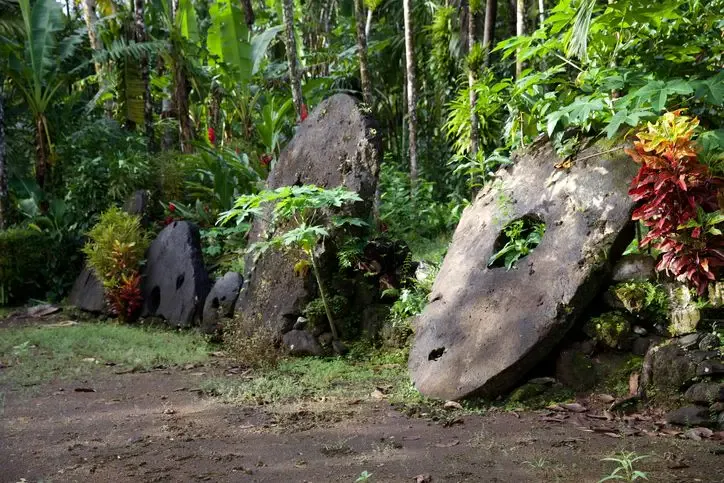
On the Pacific island of Yap, the inhabitants used massive stone discs known as 'Rai' or 'Fei' as currency to buy land and arrange marriages. Ownership was transferred by public announcement before witnesses, without moving the stone, in a system based on trust and collective memory.
From gold and silver coins to paper banknotes, and then to balances transferred today with the tap of a finger, the form of money has changed over the ages. But money has another, far stranger story on the island of Yap in the western Pacific; there, land was bought and marriages were arranged with a stone. Yes, a massive stone disc was enough to pay for a plot of land, and the entire deal could be concluded while the stone stayed where it was, on the side of the road.
The people of Yap knew the story of each stone, remembering the names of those who brought it across the sea and of those to whom its ownership passed. Once they witnessed its sale, its new owner could dispose of it without moving it an inch. Perhaps the most telling story about this money is that of a disc that sank in a storm before reaching the island's shore. The men who had carried it returned and described it to the islanders, and one family passed it down from generation to generation; it remained counted as part of their wealth as it lay on the seabed.
The 'Rai' Currency and Limestone Discs
Yap lies at the western end of the Caroline Islands in the Pacific, and its traditional currency is called 'Rai' or 'Fei'—massive discs of limestone, each with a hole in the center, according to the 'Neomano' website. A small disc is the size of a cartwheel, while the large pieces exceed three meters in diameter and weigh more than four tons. The people of Yap used them to buy land, conclude marriages, and pay ransoms.
A Journey Across the Ocean
The stone from which the money was made does not exist on Yap. Its people tell of a man named Anagumang who sailed centuries ago to the islands of Palau, more than 400 kilometers southwest of Yap, where he discovered a shimmering crystalline calcite rock inside caves. Legend has it that the first pieces were carved in the shape of fish, lizards, and turtles, before the choice finally settled on the form of a full moon with a hole in the middle.
The men carved the discs in Palau's quarries with primitive tools of stone and shell, and each expedition included dozens of men and set out with a chief's permission, sometimes taking months or years. They had to extract the stone, carve it, and lower it into the sea, then bring it back in canoes or bamboo rafts across hundreds of kilometers. The sea often swallowed a stone, and sometimes a man.
Ownership Changes… The Stone Stays
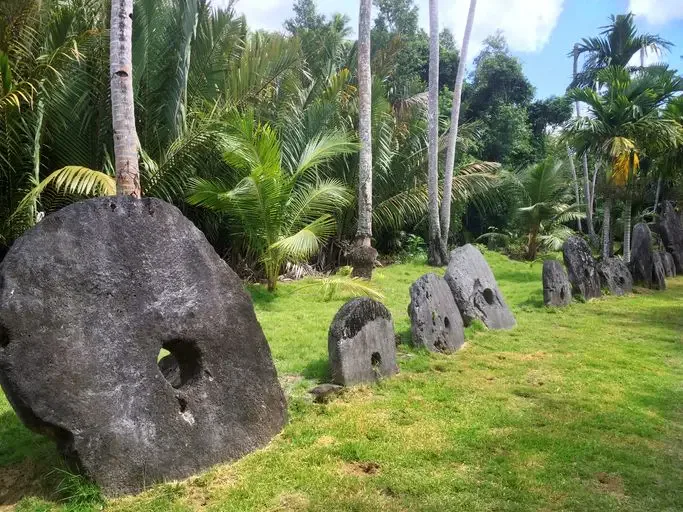
No one moved the large disc each time its owner changed; the most valuable pieces remained in the same spot for years, even generations—in front of a chief's house, beside a path, or in a village square. Ownership was transferred by public announcement: when a family paid a stone for land, the transaction took place before witnesses and became part of the piece's history, which everyone knew.
Size alone was not the measure of value; the stone's story counted even more. A piece brought by a famous navigator was worth more than another of equal size, and if men died while transporting it, its standing rose.
A Fortune at the Bottom of the Sea
In 1903, American anthropologist William Henry Furness spent several months on Yap, then published his 1910 book 'The Island of Stone Money,' recording an account that caught economists' attention. His friend Fatumak told him that a family in a nearby village possessed a fortune no one doubted, even though no one had ever seen it: that fortune was a colossal 'Fei' disc that had lain on the seabed for generations.
One of the family's ancestors was bringing the stone back from Palau when a storm surprised the raft, and to save their lives the men cut loose what tied the stone, and it sank. When they arrived, they testified before everyone to its size and quality, and the villagers accepted their testimony and considered the incident a matter of little importance—the stone was there off the coast, carved as it should be. Furness wrote that its purchasing power remained as if it were leaning against the wall of its owner's house.
Captain O'Keefe and Inflation
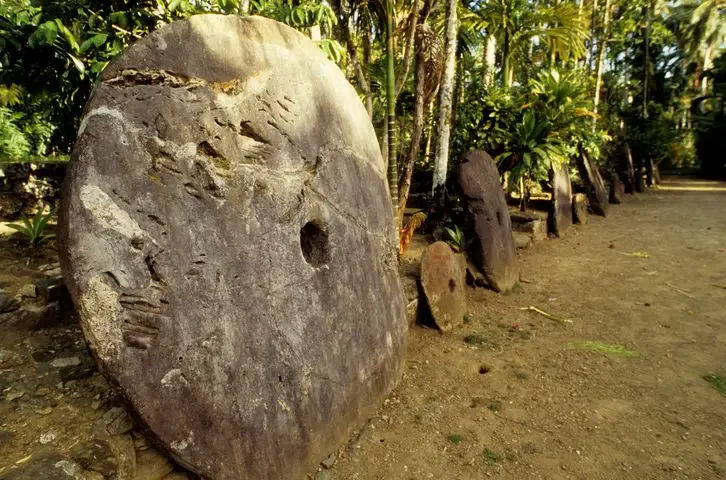
In 1871, the ship of American trader David O'Keefe wrecked near Yap; the inhabitants rescued him and he decided to stay and make his fortune, and his trade in coconut meat and sea cucumbers flourished. Then he discovered the bigger opportunity: with his ships and iron tools, he brought stones from Palau in sizes no canoe could have carried, and traded them for coconut meat.
The people of Yap accepted the deal, but they valued the new pieces at a lower price, for they had arrived without canoe voyages and months of labor, and without anyone losing his life on the way. Thus the island came to know inflation in its own way.
A Black Mark on a Stone
In 1899, Spain sold the Caroline Islands to Germany, and the colonial administration ordered the chiefs to repair the paved roads. They ignored the order, for the roads seemed perfectly fine to them. The administration then sent an envoy who painted a black cross on the most valuable 'Fei' discs, signaling their confiscation for the government's benefit. Thus Germany laid its hands on the island's wealth without moving a single stone.
According to the story, the inhabitants repaired the roads from beginning to end, whereupon the administration erased the black marks and considered the fine paid.
Trust Is the Real Guarantee
Yap's experience deserves to be taken seriously: the islanders had a ledger of accounts preserved in their collective memory, and what an individual owned was an oral entry whose validity was attested by witnesses. Two researchers likened this system to a prototype of 'Bitcoin,' or something like a 'blockchain' running without electricity, for a bank balance is an entry recognized by the bank, not a bundle of banknotes.
The people of Yap trusted their community's memory, while we place our trust in banks, states, and computer servers. The means changed, but mutual recognition of ownership remained the basis of every transaction.
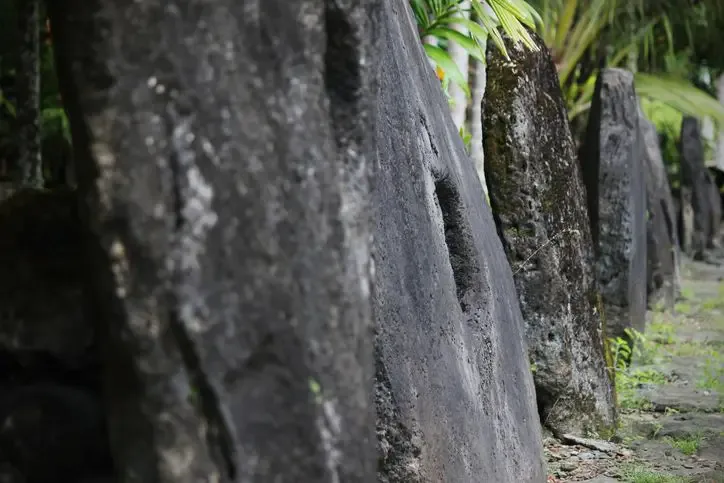
To this day, the stones remain in place; around six thousand large discs line the fronts of houses and the sides of roads, and their image appears on car license plates as part of the island's identity. New stones are no longer quarried, but the old discs still pass between families in marriages and traditional agreements, alongside the dollar used in stores.
And when a son of Yap points to a moss-covered disc, he summons something the eye cannot see: the story of who brought the stone, who paid for it, and who agreed that it had value. In that agreement, whatever the form of money, lies the essence of money.