Indonesia Seizes Ship Carrying 405 Tonnes of Substance Used in Solid Rocket Fuel
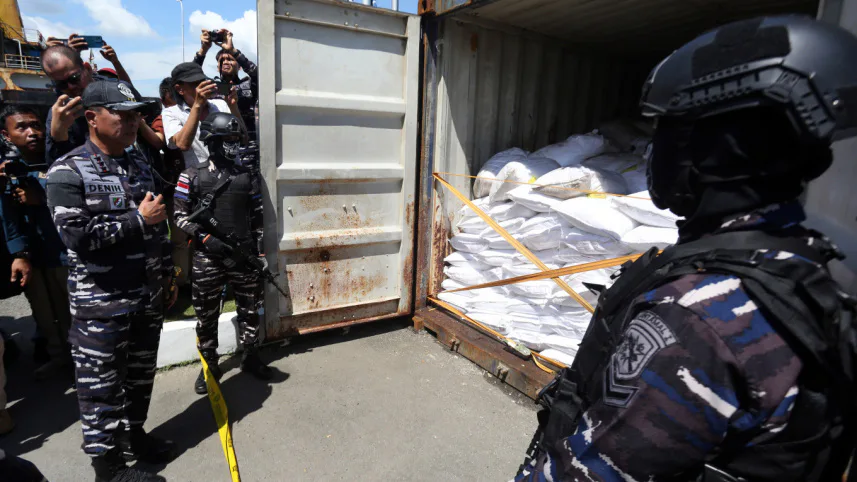
The Indonesian navy seized the Comoros-flagged cargo ship MV Star Line off Belawan port in North Sumatra, carrying 405 tonnes of sodium perchlorate, an oxidizer used in the manufacture of solid rocket fuel, with the navy estimating the quantity could be enough to produce around 100 rockets. The vessel was halted on November 7 after suspicious movem…
The Indonesian navy seized a Comoros-flagged cargo ship off Belawan port on northern Sumatra island carrying 405 tonnes of sodium perchlorate, an oxidizer used in the manufacture of solid rocket fuel, with the navy command estimating the quantity could be enough to produce around 100 rockets.
The navy said the patrol vessel KRI Sigalu-857 of the First Naval Area Command halted the MV Star Line on Saturday, November 7, after the Sea Vision maritime surveillance system detected suspicious movements by the vessel in Belawan waters, and that an inspection of 36 containers on board revealed the substance distributed across 15 containers.
Indonesian navy fleet commander Vice Admiral Dhinny Hendrata announced details of the operation at a press conference at the command headquarters in Belawan on Friday, November 20, saying it was "part of efforts to strengthen surveillance and law enforcement in Indonesian waters" and that the seized quantity "could support the production of up to around 100 rockets."
كيف أُوقفت السفينة؟
First Naval Area Commander Rear Admiral Denny Septiana said the ship had anchored off Belawan to refuel, and that a naval patrol made contact with it after it deviated from its designated route, while the navy said it had not responded to radio calls.
Septiana noted that the ship's documents show validity until October 8, 2027, but with a "suspended" status, amid suspicions that some of its documents were forged. Alongside the chemical, 54 pallets of unregistered empty 4G SIM cards were found, though their exact number was not disclosed.
The navy said all the seizures, along with the ship's captain and crew, are now in the custody of the authorities, and that the investigation is being conducted with the participation of the police, customs, immigration, the attorney general's office, the forensic laboratory of the North Sumatra police, and the narcotics control agency, examining discrepancies in the documents, the legality of the voyage, and compliance with rules on transporting dangerous goods. The navy has so far not disclosed the name of the shipping company, the owners of the cargo, or the receiving party.
من الصين إلى بنغلاديش؟
Ship-tracking data shows the MV Star Line sailed from the Chinese port of Lianyungang on September 12, with its registered destination the port of Mongla in Bangladesh and an expected arrival date of November 8, meaning the voyage lasted some 55 days before it stopped in Belawan. The crew was quoted as saying the ship was traveling from China to Bangladesh and had stopped to refuel.
However, Mongla customs commissioner Mohammad Gias Kamal said: "We have no information about the vessel, and no general import declaration has been filed for it," adding: "We cannot confirm the identity of its local shipping agent." Chittagong customs likewise confirmed the ship filed no import declaration and did not enter Bangladeshi waters, and that Chittagong port had not handled any imports of the substance since July 2025.
Bangladeshi customs data shows the country's total imports of sodium perchlorate since 2010 do not exceed 685 kilograms, whereas the seized shipment amounts to 405,000 kilograms.
Mohammad Idris Ali, vice president of the Bangladesh Chemical Society, called on the relevant government agencies to "gather accurate information about the matter and make it public," while no official position has yet been issued by either the Bangladeshi or Chinese governments.
ما بيركلورات الصوديوم؟
A chemical oxidizer that does not explode or burn on its own, it is used mainly to produce ammonium perchlorate, the main oxidizer in solid rocket fuel when mixed with aluminum powder and binding agents. It has limited civilian uses in fireworks, chemical, pharmaceutical, and laboratory applications, and is classified as a dual-use substance.