Saudi Arabia: An Indispensable Crossroads
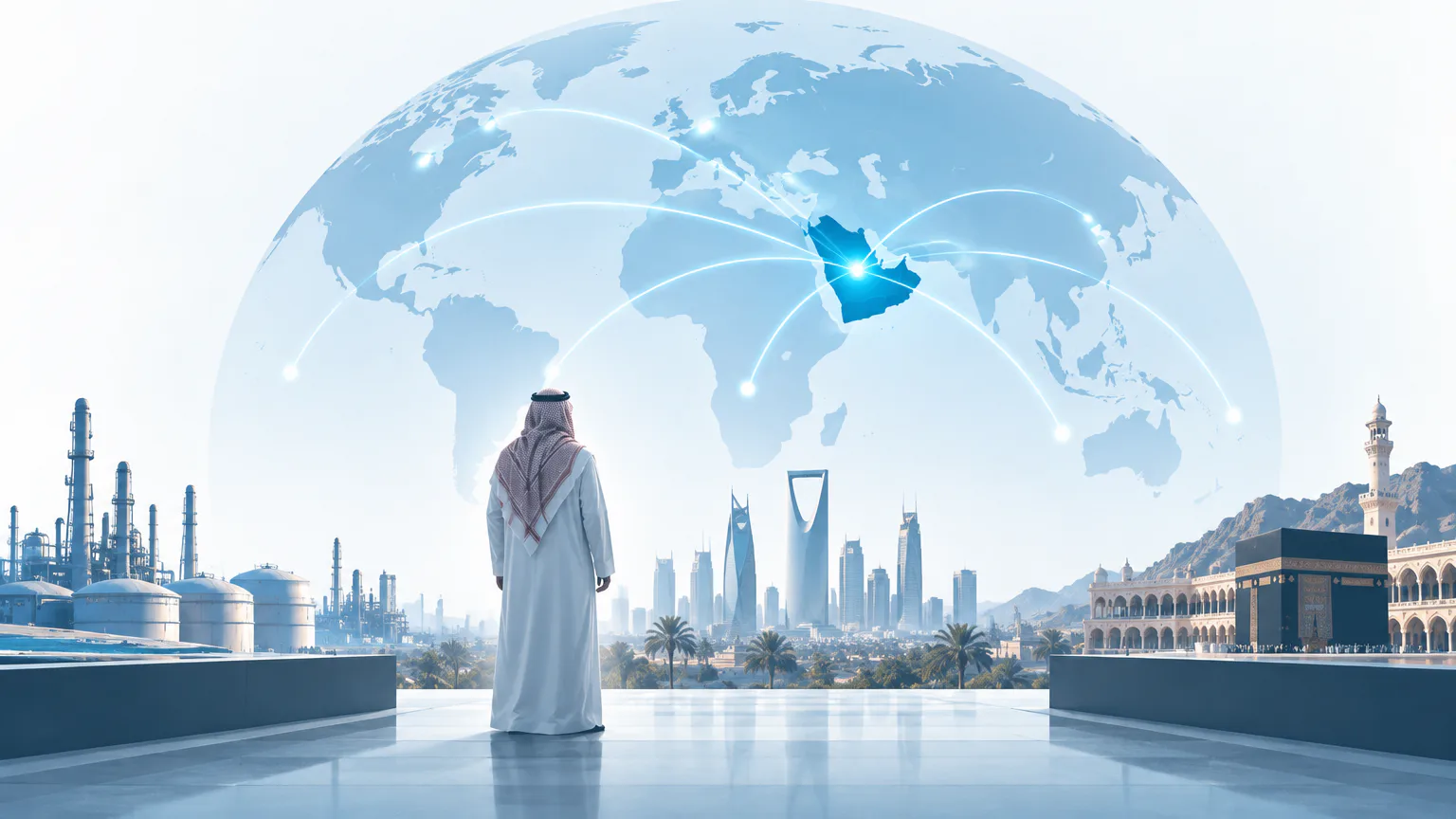
The writer argues that international politics is an interlocking web of interests, not a chessboard between two rivals, and that a state's strength is measured by the number of major interests that pass through it, not by the number of its adversaries. Saudi Arabia's standing, he says, is the fruit of turning its location, energy, spiritual weight and economy…
International politics is not a chessboard between two rivals; it is an interlocking web of interests in which economy connects to security, technology to trade, and geography to the future of decision-making. That is why the most important question is not: how many adversaries can a state defeat? But rather: how many major interests pass through it, and how many decisions are hard to make without it?
This is the deeper meaning of Saudi Arabia's standing today. It rests not on geography alone, nor on energy alone, nor on its spiritual weight alone, but on its ability to turn all of that into an influential role: a location connected to trade flows, energy connected to market security, an economy that attracts investment, an Islamic depth that balances the region, and a forward-looking vision that builds partnerships in which the world finds real interest.
The events of the hour reveal the meaning of this standing clearly. When sea lanes are disrupted, supply chains are redrawn, and competition intensifies over energy, technology and industrial centers, stability ceases to be a local affair, and geography becomes more than lines on a map. States are then measured by their ability to secure the road, reassure the market, and bring parties together around shared benefit.
That is where the real crowding lies: at the intersection of energy security with the protection of navigation, regional stability with investment confidence, and technological ambition with market flexibility. The world does not rally around slogans, but around benefit that is hard to do without. And the more keys a state holds to these files, the more bypassing it becomes a political, economic and security cost, not a passing option.
A state is not measured only by what it holds in its coffers, but by the useful doors it opens for others without compromising its own national door. Every port that shortens time, every project that links continents, every industry that adds value, every mutual investment is a new thread in the web of conscious sovereignty. And when these threads multiply, the state no longer remains on the margins of the picture; it enters its engineering.
In this context, partnership is not a diplomatic label or a commemorative photo; it is an arrangement of interests that ties the other side's success to your own. Partnership in industry creates a market, skills and jobs; in logistics it protects a supply chain; in technology it localizes knowledge; and in security it raises the cost of tampering with stability. That is how interests converge around a state, not out of courtesy, but because its presence has become part of the soundness of the equation.
In a sense close to what Hannah Arendt asserted: power is not produced by isolation, but by the capacity for joint action. A state's strength therefore lies not in standing alone in the arena, but in the arena coming to need it: a safe road for trade, a reliable berth for capital, a bridge between regions, and a partner without whom the region's security cannot hold.
There is a great difference between a state that is summoned when needed and then forgotten, and a state whose account is settled before any step that touches it is taken. The first receives the outcomes of the game; the second takes part in writing its rules, because whoever holds the keys to the road does not wait for permission to cross.
But partnership is not subservience, and openness is not concession. A state with many bridges is less vulnerable to blackmail, and one that diversifies its partners does not mortgage its future to a single window. The wisdom lies in cooperating without subjugation, exchanging benefits without naivety, and turning partnerships into tools for distributing risks and opening alternatives when the winds shift. Many doors do not dissipate sovereignty; they protect it.
That is why the economy is the most enduring language of intersection. Speeches make an echo, but ports, markets, factories and universities make a bond. And when the relationship shifts from a supplier one buys from to a partner one builds with, stability becomes an interest that states, companies and markets defend together. A supplier can be replaced, but a partner that combines location, competence, reliability and the capacity to deliver is hard to bypass.
Building this position is no easy task; as Machiavelli said: "There is nothing more difficult, more dangerous, or less certain of success than establishing a new order." Yet this is the essence of the Saudi transformation: building the economy of the future as a sovereign decision, not merely a development plan. A city that attracts business, a port that shortens time, a university that produces knowledge, an industry that raises value — all are cards of strength that cement standing in the circles of decision-making.
Even so, interest without principle may win a round and lose a nation, and partnership without limits may turn into a burden. Sovereignty, security, the dignity of decision-making, the unity of society and the future of generations therefore remain constants that are not negotiated, while everything else is managed with the flexibility of reason, not the rigidity of illusion; flexibility in means does not mean abandoning the ends.
Saudi Arabia does not wait for a green light granted by anyone; it is building the credit that makes its presence a condition for the success of the major equations. Standing is not preserved by slogans, but by work, projects, trust and shared interest. Winning is not having the largest number of pieces, but the largest number of intersections; for the intersection that combines economy with security, location with knowledge, and partnership with sovereignty is what gives the state its widest margin in decision-making.
That is Saudi Arabia's secret: it does not wait for the world to clear a path for it, but turns the world's interests into a path that leads to it. And when interests converge around it, because the world needs its stability, its location, its competence and its partnerships, it becomes a crossroads that cannot be bypassed.