Winton: AI Accelerates Marketing but Does Not Change the Fundamentals of Business Success
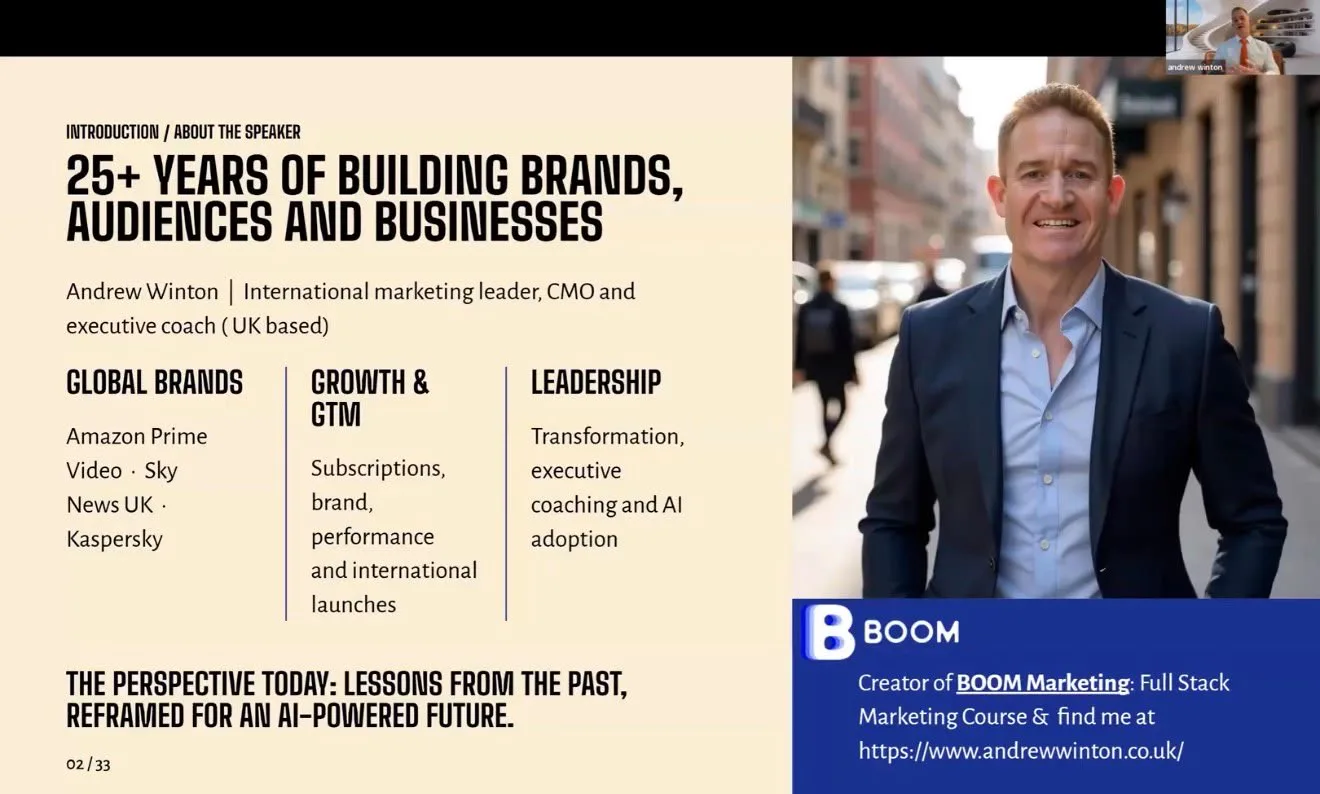
Andrew Winton, Global Executive for Marketing and Media, affirmed during a session organized remotely by the Media and Innovation Community that artificial intelligence raises the speed and efficiency of marketing work, but does not change the fundamentals of lasting success, stressing that human judgment and professional accountability remain at the heart of decision-making.
The Media and Innovation Community, affiliated with the Community Innovation and Sustainability Association, organized a session titled "The Future of Media, Marketing and Innovation Leadership in the Age of Artificial Intelligence" on the evening of November 25, 2026, at 7:00 p.m. via a remote video meeting, with simultaneous interpretation into Arabic.
The session hosted Andrew Winton, Global Executive for Marketing and Media and a digital transformation strategist, who has extensive professional experience with a number of international brands and organizations, including Amazon Prime Video, Sky, Kaspersky, World Chase, The Times, and Truth Engine.
The session addressed the role of artificial intelligence in reshaping the media and marketing sectors, accelerating innovation, developing new business models, and enhancing team efficiency, while emphasizing the importance of keeping human judgment and professional accountability at the core of the decisions and outputs these technologies produce.
Winton explained that artificial intelligence changes how marketing work is executed in terms of speed, scale, and efficiency, but does not change the foundations on which sustainable business success rests. These foundations include understanding customer needs, building brand and trust, deploying creativity effectively, testing hypotheses and measuring results, as well as maintaining human accountability in decision-making.
The session reviewed four main pillars of innovation: the first addressed innovation in marketing and media, and the role of outstanding campaigns in creating tangible impact and building a stronger relationship with audiences. The second focused on innovation with artificial intelligence and digital transformation, and how modern technologies can contribute to building new business models within the media sector and various business sectors.
The third pillar explored innovation in business partnerships and audience engagement, through building global partnerships between brands in ways that support commerce, creativity, and growth. The fourth addressed innovative leadership in the digital age, and the role of leaders in fostering innovative thinking and driving transformation within organizations.
Winton noted that organizations do not need to use artificial intelligence simply for the sake of using it; rather, it should be tied to a clear problem and measurable value. He pointed out that the most important question facing marketing teams is not how many tools they can run, but their ability to deliver better, more relevant solutions to customer needs.
The speaker also touched on a number of applications and practical models, including the Nomi AI platform, which uses artificial intelligence to aggregate news and personalize it according to users' interests, and Squidgy AI, a company specializing in building low-code AI agents. He explained that these agents can help teams analyze data, identify opportunities, prepare recommendations, and participate in some operational and marketing tasks.
The session also addressed the impact of artificial intelligence on personalizing messages and campaigns, audience segmentation, content testing, and reviewing marketing materials and translated copies, enabling time savings and reduced costs. Winton, in turn, stressed the need for those responsible to review messages, claims, and visual outputs before publication, emphasizing that AI agents bear no responsibility for the decisions they propose.
Winton warned of the risks of fake ratings and reviews, which can undermine consumer trust and distort their choices, affirming that the brands that achieve long-term trust are those that provide genuine, useful reviews that comply with regulatory requirements in the markets where they operate.
At the close of the session, Winton presented a practical 30-day plan for teams to trial artificial intelligence, starting with identifying a clear problem or workflow, assigning an owner to it, and measuring current performance levels, then testing a tool or AI agent on a limited scale, before evaluating the results in terms of output quality, time, costs, and actual improvement.
Winton affirmed that innovation is a leadership choice, calling on organizations and teams to try new solutions and keep testing, while stressing that the customer must remain at the center of decision-making, and that technology is a means of delivering real value, not an end in itself.
The session was part of efforts to promote knowledge of modern technologies, support innovation, and develop professional practices in the fields of media, marketing, and business, and to open spaces for dialogue on the future of digital transformation and artificial intelligence.