Hajj and Umrah Ministry Reviews 2026 Achievements in Service Development and Enhancing Hajj and Umrah Sector Efficiency
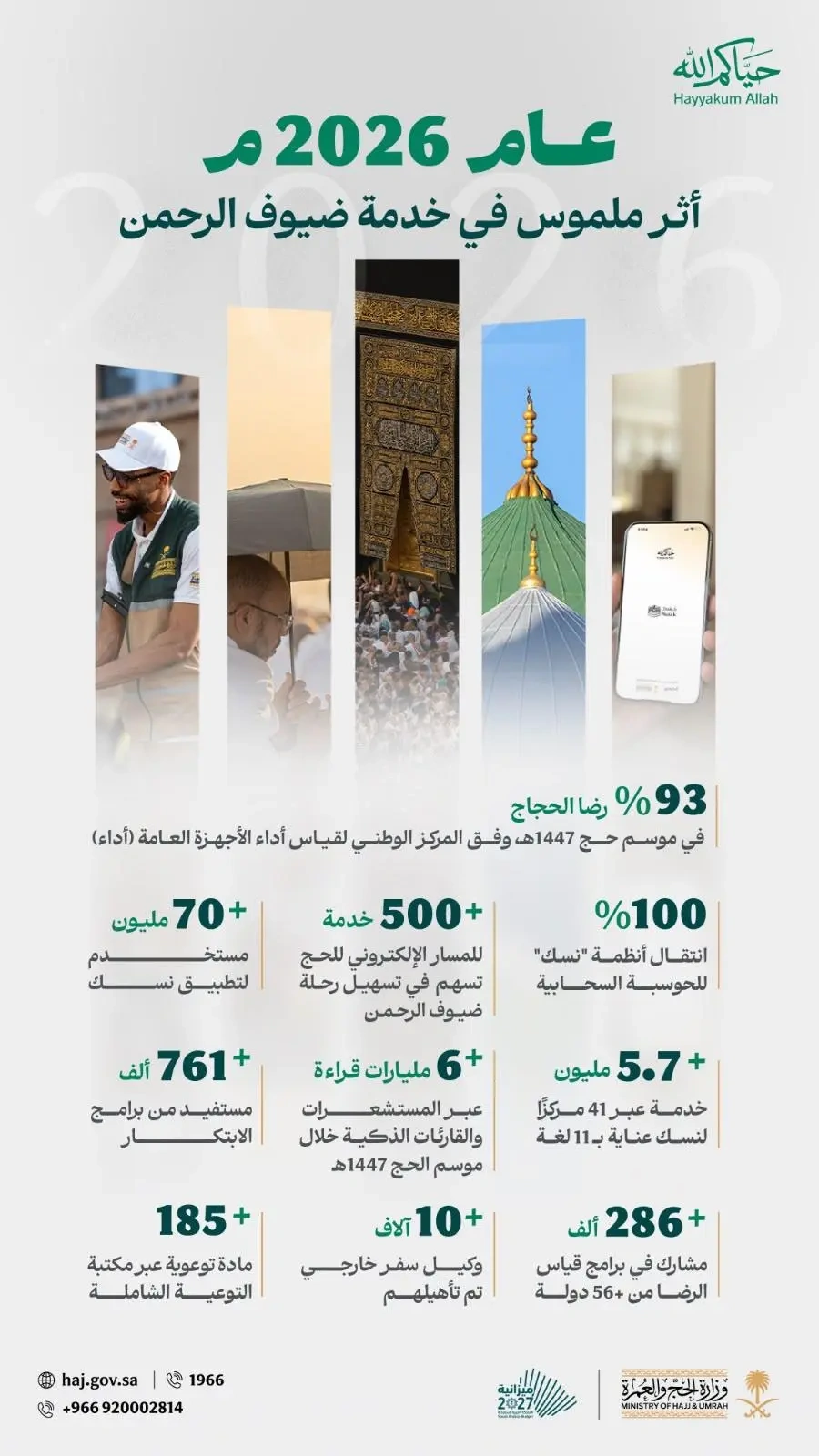
The Ministry of Hajj and Umrah reviewed its key achievements and performance indicators for 2026, realized by the grace of God and the support and attention given by the wise leadership — may God support it — to serving the Guests of God. These included developing digital services, facilitating the arrival of pilgrims from around the world, raising operational efficiency, improving the experience of Hajj and Umrah pilgrims, and promoting innovation and investment in the Hajj and Umrah sector, in line with the targets of Saudi Vision 2030 and the Guests of God Service Program.
The year saw progress in developing services for the Guests of God through expanding digital solutions, improving operational efficiency, and enhancing responsiveness to beneficiaries' needs, alongside developing awareness services and employing data and smart technologies to monitor pilgrim movements and raise readiness during peak seasons. This contributed to raising pilgrim satisfaction with services during the 1447 AH Hajj season to 93%, according to measurement results by the National Center for Performance Measurement of Public Agencies (ADAA).
In facilitating the Umrah journey, the Ministry enabled pilgrims to book Umrah and visitation packages via global and regional online travel platforms, through digital channels combining package search, booking, and visa issuance, while qualifying more than 10,000 foreign travel agents, expanding options for pilgrims from around the world.
Facilitation efforts included the multi-entry Umrah visa, which grants pilgrims flexibility to repeat visits and perform Umrah, with the possibility of stays of up to 90 days per year, contributing to broader trip planning options and supporting demand for accommodation, transport, and hospitality services.
In developing services for pilgrims from abroad, the number of service-providing companies rose to 33, an increase of 20%, expanding pilgrims' options and raising competitiveness among service providers. Efforts to enrich the Guests of God's experience included increasing the number of enrichment sites in Makkah and Madinah to more than 90, allowing pilgrims and Umrah performers to explore historical and cultural landmarks related to their journey.
In digital transformation, the "Nusuk" app surpassed 70 million users worldwide, offering more than 130 digital services that bring the Guests of God's needs together in a unified platform, from trip planning to completion of rituals. The electronic Hajj path also provides more than 500 services facilitating the Guests of God's journey.
In measuring beneficiary satisfaction, more than 286,000 people participated in satisfaction measurement programs covering more than 56 countries and more than 150 service-providing companies, enabling monitoring of the Guests of God's experience, identifying improvement opportunities, and developing services based on measurement results and pilgrims' needs at various stages of their journey.
The Ministry continued developing care channels for the Guests of God and responding to their needs: 41 "Nusuk Care" centers delivered more than 5.7 million services in 11 languages, while beneficiary satisfaction with the unified number (1966) services, offered in 7 languages, reached about 90%, facilitating communication with the Guests of God and providing support in their various languages.
In terms of operational readiness, the use of sensors and smart readers during the 1447 AH Hajj season recorded more than 6 billion readings, enabling real-time monitoring of pilgrim movements and analysis of densities and flows, supporting rapid decision-making and field team deployment, contributing to improved crowd management mechanisms, organizing pilgrim movement, and ensuring smooth movement between the holy sites.
The Ministry achieved progress in developing its technological infrastructure by completing the 100% migration of Nusuk systems to cloud computing, which raised system availability to 99.99%, accelerated request processing by more than 50%, reduced costs by 29%, strengthened business continuity and spending efficiency, and enhanced the readiness of digital services to accommodate growing demand during Hajj and Umrah seasons.
In awareness and guidance, the Ministry developed the "Comprehensive Awareness Library," containing more than 185 multimedia awareness materials, including visual content, designs, and guidance messages, providing reliable information accompanying pilgrims and Umrah performers before and during their journey, and supporting delivery of guidance to beneficiaries in their various languages and needs.
The Ministry's achievements included preparing 11 prayer sites under the "All of Makkah is a Sanctuary" initiative, with a capacity exceeding 120,000 worshippers, facilitating prayers and reducing congestion during peak seasons, alongside establishing a pilgrim city in the Al-Jouf region covering 12,000 square meters, whose services benefited more than 18,000 arrivals through the Kingdom's northern land ports.
In innovation and entrepreneurship, the Ministry supported the development of solutions serving the Hajj and Umrah sector through programs and initiatives benefiting more than 761,000 beneficiaries, with the participation of 263 teams from more than 28 countries, and supported 45 companies in developing more than 200 prototypes, alongside empowering entrepreneurs and small and medium-sized enterprises via the "Nusuk Business" platform, expanding national enterprises' participation and developing services for the Guests of God.
These achievements reflect the progress made during 2026 in developing the Hajj and Umrah sector through integration between government agencies and the private and nonprofit sectors, investment in modern technologies, raising operational efficiency, and enhancing beneficiary participation in improving services, extending the support given by the wise leadership — may God support it — to serving the Guests of God, and achieving Saudi Vision 2030 targets of facilitating the hosting of more Hajj and Umrah pilgrims, elevating service quality, and enriching their religious and cultural experience.
// End //